> For the complete documentation index, see [llms.txt](https://docs.pirlmeet.com/llms.txt). Markdown versions of documentation pages are available by appending `.md` to page URLs; this page is available as [Markdown](https://docs.pirlmeet.com/faq/learn/basics/accounts/pure-proxy-accounts.md).
# Pure Proxy Accounts
### Anonymous Proxy (Pure Proxy)[](https://wiki.polkadot.network/docs/learn-proxies-pure#anonymous-proxy-pure-proxy)
THE ACCOUNT TAB IN THE POLKADOT-JS UI CANNOT HANDLE COMPLEX PROXY SETUPS
The Accounts Tab in the Polkadot-JS UI cannot handle complex proxy setups (e.g. a proxy -> multisig -> a pure proxy which is part of another multisig). These complex setups must be done using the [Extrinsics Tab](https://polkadot.js.org/apps/#/extrinsics) directly.
**We recommend to use the** [**Westend Testnet**](https://wiki.polkadot.network/docs/learn-DOT#getting-tokens-on-the-westend-testnet) **if you are testing features for the first time.** By performing the complex proxy setups on the testnet, you can comfortably replicate the procedure on the main networks.
RISK OF LOSS OF FUNDS
Read carefully the text below and before performing any action using anonymous proxies on Polkadot, experiment on the Westend testnet.
Anonymous proxies (pure proxies) are very different from other proxy types. The proxies we described so far are *existing accounts* assigned as proxies by a primary account. These proxies act on behalf of the primary account, reducing the exposure of the primary account's private key. Remember, the more often we use an account's private key to sign transactions, the more we expose that key to the internet, increasing the visibility of that account. The purpose of a proxy is thus to draw the attention of potential attackers away from the primary account, as proxies' private keys will be used most of the time to perform actions on behalf of the primary account.
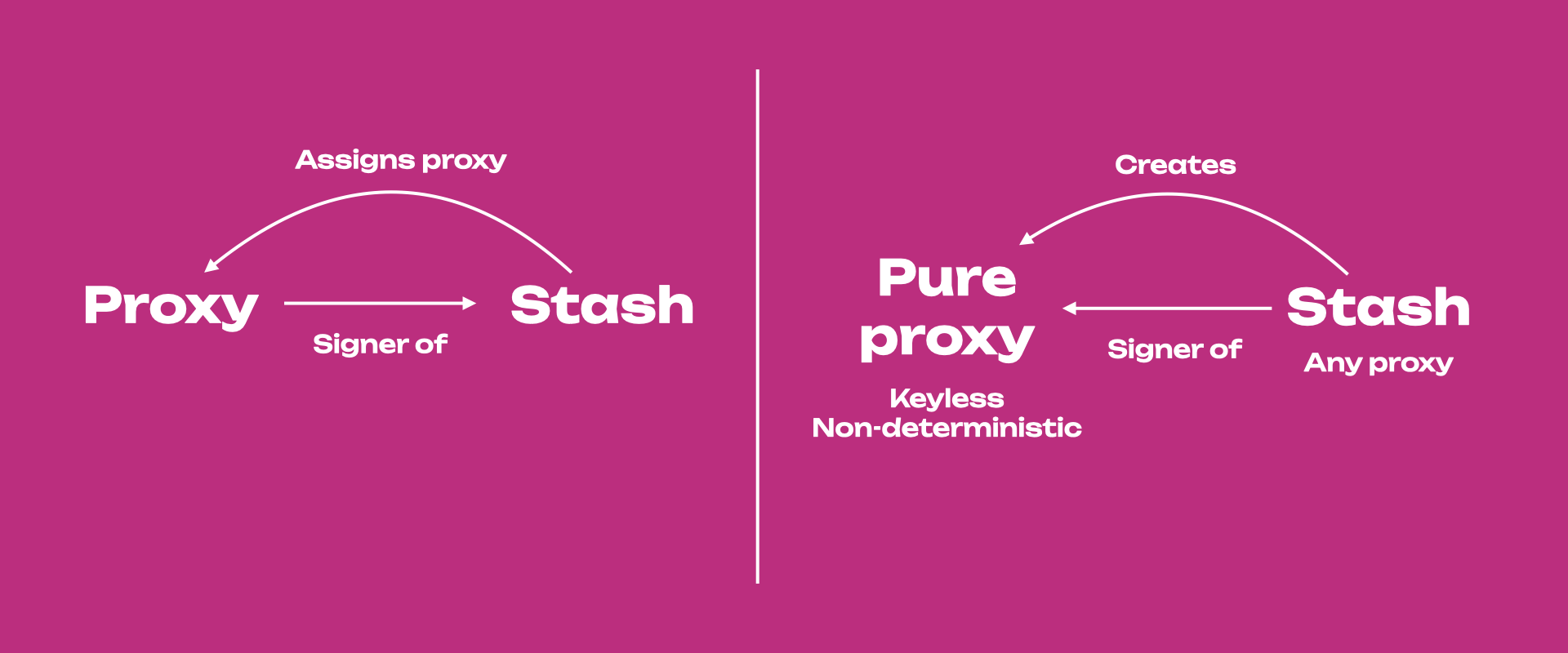 Anonymous proxies (pure proxies) are new accounts that are *created* (not assigned) by a primary account. That primary account then acts as *any* proxy on behalf of the anonymous proxy. Anonymous proxies are **keyless non-deterministic accounts** as they do not have a private key but they have an address that is randomly generated. Also, in some sense, nobody owns an anonymous proxy as nobody has a private key to control them.
RENAMING ANONYMOUS PROXIES AS **PURE PROXIES**
Anonymous proxies are not anonymous because they have an address that is spawned by a primary account acting as *any* proxy. Even if the *any* proxy changes, it is still possible to find who generated the *anonymous* proxy by going backward using a block explorer. There was thus the need to change the name of *anonymous* proxy. People suggested *keyless accounts* since they do not have a private key and are proxied accounts. However, multisig accounts are also keyless (but deterministic). Moreover, even if *anonymous* proxies are proxied accounts, they can still act as proxies and control other accounts via proxy calls (see multisig example below). Thus, the name that has been chosen is **pure proxy**. If you want to know more about the reasoning behind renaming of pure proxies, see the discussion in [this PR](https://github.com/paritytech/substrate/pull/12283) or the discussion on [Polkadot forum](https://forum.polkadot.network/t/parachain-technical-summit-next-steps/51/14).
From now on we will thus use the term pure proxy instead of anonymous proxy.
### Create and Remove Pure Proxy[](https://wiki.polkadot.network/docs/learn-proxies-pure#create-and-remove-pure-proxy)
INFO
To create a **pure proxy** see [this support article](https://support.polkadot.network/support/solutions/articles/65000182196), or watch [this technical explainer video](https://www.youtube.com/watch?v=T443RcCYP24).
REMOVING PURE PROXIES
The procedure for removing a *pure* proxy is different from the one used to remove other proxies. Visit the section "Removing an Anonymous Proxy" on [this support article](https://support.polkadot.network/support/solutions/articles/65000182196), or watch [this technical explainer video](https://www.youtube.com/watch?v=T443RcCYP24).
EXPLAINER VIDEO ON PURE PROXIES
Learn more about pure proxies from our [technical explainer video](https://www.youtube.com/watch?v=YkYApbhU3i0).
### Use of Pure Proxy[](https://wiki.polkadot.network/docs/learn-proxies-pure#use-of-pure-proxy)
The use of the *pure proxy* is strictly bound to the relationship between the *pure proxy* and the *any* proxy. Note that the *any* proxy does not necessarily be the one who created the *pure proxy* in the first place. Hence, *pure proxies* are not really owned by somebody, but they can be controlled. Once that relationship between the *pure proxy* and its *any* proxy is broken, the *pure proxy* will be inaccessible (even if visible on the Polkadot-JS UI). Also, *pure proxies* are non-deterministic, meaning that if we lose one *pure proxy*, the next one we create from the same primary account will have a different address.
*Pure proxies* cannot sign anything because they do not have private keys. However, although they do not have private keys and cannot sign any transaction directly, they can act as proxies (or better, proxy channels) within `proxy.proxy` calls (proxy calls). For example, it is possible to have *pure proxies* within a multisig. Using proxy calls, it is possible to use the *any* proxy to call the *pure* proxy, which in turn will do a multisig call. More about this later on.
DANGER
Once you remove the relationship with *any* proxy, the *pure* proxy will be inaccessible. Also, *pure* proxies cannot sign for anything.
### Why Pure Proxy?[](https://wiki.polkadot.network/docs/learn-proxies-pure#why-pure-proxy)
Despite their complexity and associated dangers, *pure* proxies have important benefits that we discuss below.
#### Enhanced Security[](https://wiki.polkadot.network/docs/learn-proxies-pure#enhanced-security)
*Pure* proxies cannot be stolen because they do not have private keys. The only accounts that have full access to the *pure* proxies are *any* proxies. Security can be further increased if the *any* proxy is a multi-signature account.
#### Simplified and Secure Account Management[](https://wiki.polkadot.network/docs/learn-proxies-pure#simplified-and-secure-account-management)
WALK-THROUGH TUTORIAL VIDEO OF ACCOUNT MANAGEMENT
You can see [this video tutorial](https://www.youtube.com/watch?v=YkYApbhU3i0) that goes through this scenario. The tutorial requires some familiarity with the Extrinsic Tab of the Polkadot-JS UI.
Probably the greatest benefit of using *pure* proxies is the management of complex account relationships at a corporate level. Let's take for example 3 accounts belonging to Charlie, Dan and Eleanor working for Company X. Charlie holds funds belonging to Company X, but he wants to leave the company and transfer the economic responsibility to Eleanor. Dan is a staking proxy of Charlie.
**Without *****Pure***** Proxy**, Charlie must (see *left* side of the Figure below):
* Remove Dan as a staking proxy, this step requires 1 signature
* Stop nominating and unbound all funds , this step requires 2 signatures
* Transfer the funds to Eleanor, this step requires 1 signature
Then Eleanor adds Dan as a staking proxy (1 signature). The whole process requires 5 signatures. Here we are presenting a simple example, in fact, with multi-signature accounts and multiple proxies the procedure would be more time-consuming and labor-intensive.
Anonymous proxies (pure proxies) are new accounts that are *created* (not assigned) by a primary account. That primary account then acts as *any* proxy on behalf of the anonymous proxy. Anonymous proxies are **keyless non-deterministic accounts** as they do not have a private key but they have an address that is randomly generated. Also, in some sense, nobody owns an anonymous proxy as nobody has a private key to control them.
RENAMING ANONYMOUS PROXIES AS **PURE PROXIES**
Anonymous proxies are not anonymous because they have an address that is spawned by a primary account acting as *any* proxy. Even if the *any* proxy changes, it is still possible to find who generated the *anonymous* proxy by going backward using a block explorer. There was thus the need to change the name of *anonymous* proxy. People suggested *keyless accounts* since they do not have a private key and are proxied accounts. However, multisig accounts are also keyless (but deterministic). Moreover, even if *anonymous* proxies are proxied accounts, they can still act as proxies and control other accounts via proxy calls (see multisig example below). Thus, the name that has been chosen is **pure proxy**. If you want to know more about the reasoning behind renaming of pure proxies, see the discussion in [this PR](https://github.com/paritytech/substrate/pull/12283) or the discussion on [Polkadot forum](https://forum.polkadot.network/t/parachain-technical-summit-next-steps/51/14).
From now on we will thus use the term pure proxy instead of anonymous proxy.
### Create and Remove Pure Proxy[](https://wiki.polkadot.network/docs/learn-proxies-pure#create-and-remove-pure-proxy)
INFO
To create a **pure proxy** see [this support article](https://support.polkadot.network/support/solutions/articles/65000182196), or watch [this technical explainer video](https://www.youtube.com/watch?v=T443RcCYP24).
REMOVING PURE PROXIES
The procedure for removing a *pure* proxy is different from the one used to remove other proxies. Visit the section "Removing an Anonymous Proxy" on [this support article](https://support.polkadot.network/support/solutions/articles/65000182196), or watch [this technical explainer video](https://www.youtube.com/watch?v=T443RcCYP24).
EXPLAINER VIDEO ON PURE PROXIES
Learn more about pure proxies from our [technical explainer video](https://www.youtube.com/watch?v=YkYApbhU3i0).
### Use of Pure Proxy[](https://wiki.polkadot.network/docs/learn-proxies-pure#use-of-pure-proxy)
The use of the *pure proxy* is strictly bound to the relationship between the *pure proxy* and the *any* proxy. Note that the *any* proxy does not necessarily be the one who created the *pure proxy* in the first place. Hence, *pure proxies* are not really owned by somebody, but they can be controlled. Once that relationship between the *pure proxy* and its *any* proxy is broken, the *pure proxy* will be inaccessible (even if visible on the Polkadot-JS UI). Also, *pure proxies* are non-deterministic, meaning that if we lose one *pure proxy*, the next one we create from the same primary account will have a different address.
*Pure proxies* cannot sign anything because they do not have private keys. However, although they do not have private keys and cannot sign any transaction directly, they can act as proxies (or better, proxy channels) within `proxy.proxy` calls (proxy calls). For example, it is possible to have *pure proxies* within a multisig. Using proxy calls, it is possible to use the *any* proxy to call the *pure* proxy, which in turn will do a multisig call. More about this later on.
DANGER
Once you remove the relationship with *any* proxy, the *pure* proxy will be inaccessible. Also, *pure* proxies cannot sign for anything.
### Why Pure Proxy?[](https://wiki.polkadot.network/docs/learn-proxies-pure#why-pure-proxy)
Despite their complexity and associated dangers, *pure* proxies have important benefits that we discuss below.
#### Enhanced Security[](https://wiki.polkadot.network/docs/learn-proxies-pure#enhanced-security)
*Pure* proxies cannot be stolen because they do not have private keys. The only accounts that have full access to the *pure* proxies are *any* proxies. Security can be further increased if the *any* proxy is a multi-signature account.
#### Simplified and Secure Account Management[](https://wiki.polkadot.network/docs/learn-proxies-pure#simplified-and-secure-account-management)
WALK-THROUGH TUTORIAL VIDEO OF ACCOUNT MANAGEMENT
You can see [this video tutorial](https://www.youtube.com/watch?v=YkYApbhU3i0) that goes through this scenario. The tutorial requires some familiarity with the Extrinsic Tab of the Polkadot-JS UI.
Probably the greatest benefit of using *pure* proxies is the management of complex account relationships at a corporate level. Let's take for example 3 accounts belonging to Charlie, Dan and Eleanor working for Company X. Charlie holds funds belonging to Company X, but he wants to leave the company and transfer the economic responsibility to Eleanor. Dan is a staking proxy of Charlie.
**Without *****Pure***** Proxy**, Charlie must (see *left* side of the Figure below):
* Remove Dan as a staking proxy, this step requires 1 signature
* Stop nominating and unbound all funds , this step requires 2 signatures
* Transfer the funds to Eleanor, this step requires 1 signature
Then Eleanor adds Dan as a staking proxy (1 signature). The whole process requires 5 signatures. Here we are presenting a simple example, in fact, with multi-signature accounts and multiple proxies the procedure would be more time-consuming and labor-intensive.
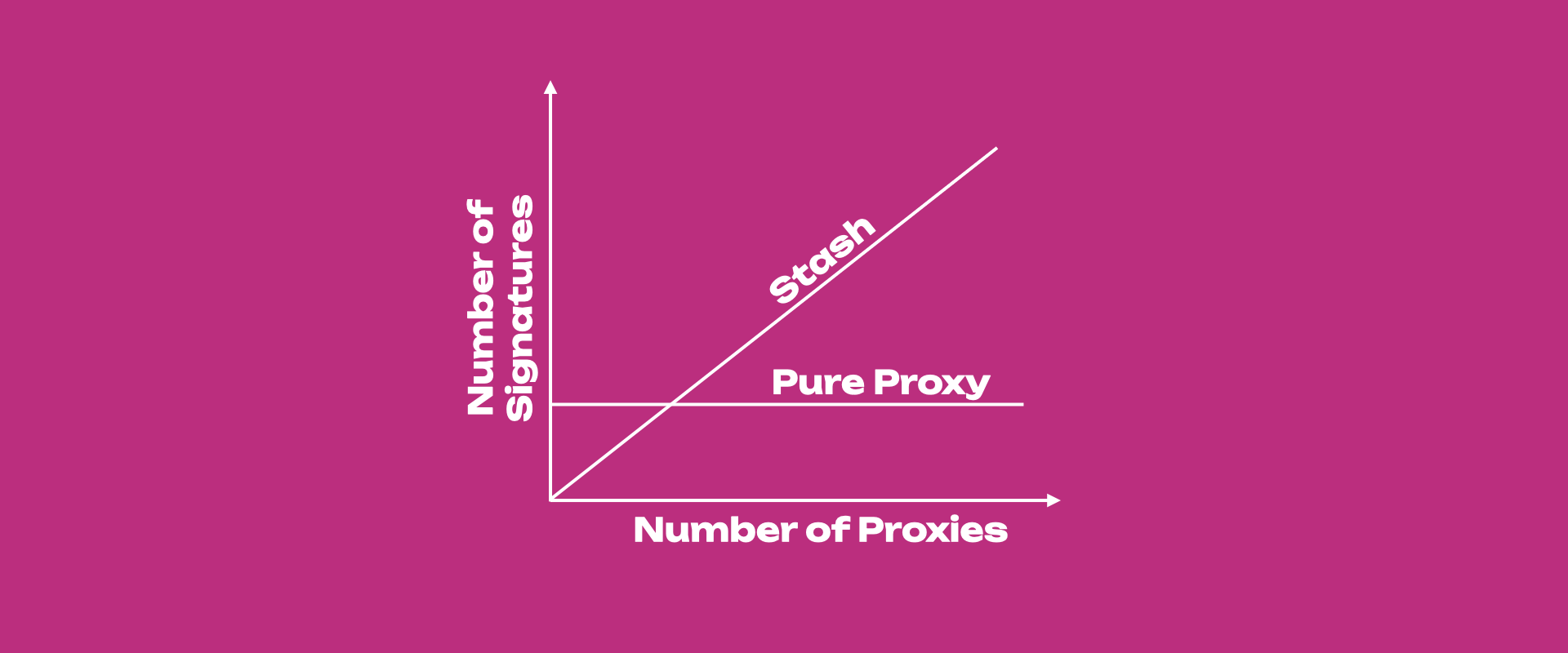
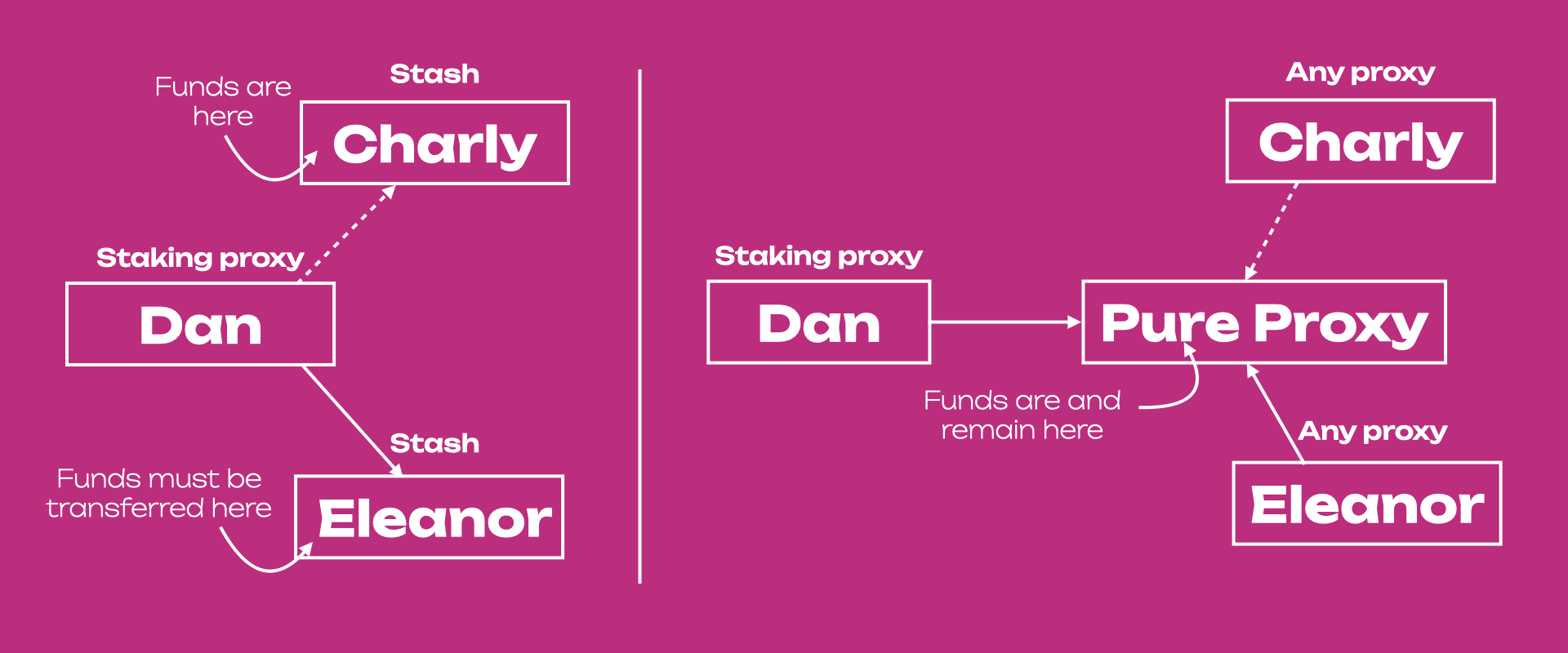 **With *****Pure***** Proxy** (see *right* side of the Figure above), Charlie must add Eleanor as *any* proxy of the *pure* proxy, and remove himself (or Eleanor can remove him). The process requires just 2 signatures (1 signature to add the new *any* proxy and 1 signature the remove the old one). The funds remain in the *pure* proxy, and it is not necessary to stop nominating or unbond funds. Also, any proxy relationships with the *pure* proxy stay in place. Thus, if we use the *pure* proxy, with an increasing number of proxies we will always have to sign twice (not necessarily true in multi-signature accounts). While if we are not using the *pure* proxy, the more the proxies the more signatures we need to detach them from the old stash and attach them to the new stash (see Figure below).
 #### Multi-signature Account Management[](https://wiki.polkadot.network/docs/learn-proxies-pure#multi-signature-account-management)
*Pure* proxies are useful to efficiently manage multi-signature (multisig) accounts. In fact, multi-signature accounts are deterministic, which means that once a multisig is created the signatories cannot be changed. If one of the signatories wants to leave the multisig, a new multisig must be created. This is inconvenient, especially at corporate-level management where the chance of replacing someone within a multisig can be high. *Pure* proxies allow keeping the same multisig when the signatories change.
**Scenario One: One Anonymous Proxy within a Multisig**[****](https://wiki.polkadot.network/docs/learn-proxies-pure#scenario-one-one-anonymous-proxy-within-a-multisig)
WALK-THROUGH TUTORIAL VIDEO
You can see [this video tutorial](https://www.youtube.com/watch?v=iGRoGstB_pQ) that goes through this scenario. The tutorial requires some familiarity with the Extrinsic Tab of the Polkadot-JS UI.
It is possible to put a *pure* proxy within a multisig, and then transactions will be signed by the *any* proxy on behalf of the *pure* proxy (proxied account). Let's take for example the diagram below. Alice, Bob and Anon are part of the multisig ABC, a multisig account with threshold 2. P-C is a *pure* proxy spawned by Charlie, who now acts as *any* proxy and thus signs anything on behalf of P-C. The *pure* proxy cannot sign directly because it does not have a private key. So, for example, to send funds from the multisig to Dan, Charly needs to submit a `proxy.proxy` extrinsic to P-C, which in turn will submit a `multisig.asMulti` extrinsic to ABC containing the call data for the `balances.transferKeepAlive` extrinsic about the transfer of some funds from ABC to Dan. Alice can then approve the transfer by submitting a `multisig.asMulti` extrinsic also containing the call data for the `balances.transferKeepAlive` extrinsic about the transfer of some funds from ABC to Dan.
#### Multi-signature Account Management[](https://wiki.polkadot.network/docs/learn-proxies-pure#multi-signature-account-management)
*Pure* proxies are useful to efficiently manage multi-signature (multisig) accounts. In fact, multi-signature accounts are deterministic, which means that once a multisig is created the signatories cannot be changed. If one of the signatories wants to leave the multisig, a new multisig must be created. This is inconvenient, especially at corporate-level management where the chance of replacing someone within a multisig can be high. *Pure* proxies allow keeping the same multisig when the signatories change.
**Scenario One: One Anonymous Proxy within a Multisig**[****](https://wiki.polkadot.network/docs/learn-proxies-pure#scenario-one-one-anonymous-proxy-within-a-multisig)
WALK-THROUGH TUTORIAL VIDEO
You can see [this video tutorial](https://www.youtube.com/watch?v=iGRoGstB_pQ) that goes through this scenario. The tutorial requires some familiarity with the Extrinsic Tab of the Polkadot-JS UI.
It is possible to put a *pure* proxy within a multisig, and then transactions will be signed by the *any* proxy on behalf of the *pure* proxy (proxied account). Let's take for example the diagram below. Alice, Bob and Anon are part of the multisig ABC, a multisig account with threshold 2. P-C is a *pure* proxy spawned by Charlie, who now acts as *any* proxy and thus signs anything on behalf of P-C. The *pure* proxy cannot sign directly because it does not have a private key. So, for example, to send funds from the multisig to Dan, Charly needs to submit a `proxy.proxy` extrinsic to P-C, which in turn will submit a `multisig.asMulti` extrinsic to ABC containing the call data for the `balances.transferKeepAlive` extrinsic about the transfer of some funds from ABC to Dan. Alice can then approve the transfer by submitting a `multisig.asMulti` extrinsic also containing the call data for the `balances.transferKeepAlive` extrinsic about the transfer of some funds from ABC to Dan.
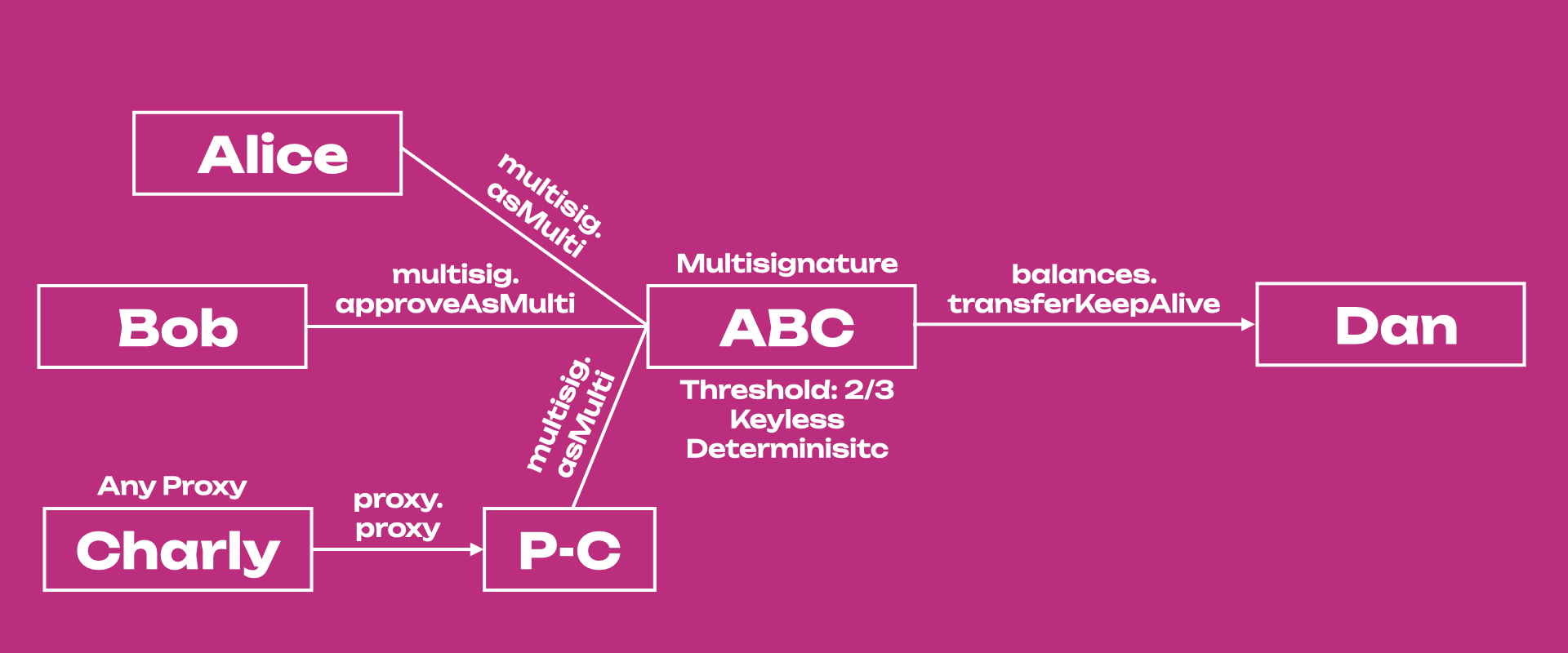 If Charly wants to leave the multisig, a new *any* proxy can be added to P-C and Charly can be removed (by himself or by the new *any* proxy). Note that the multisig also contains Bob that in this specific example does not do anything.
PROXY CALLS
To use a *pure* proxy within a multisig you need to use the Extrinsic Tab and generate a `proxy.proxy` extrinsic. If you try to sign a multisig transaction using the *pure* proxy you will be prompted with a warning. Remember, you cannot sign something directly if you do not have a private key.
**Scenario Two: Multisig made of Anonymous Proxies**[****](https://wiki.polkadot.network/docs/learn-proxies-pure#scenario-two-multisig-made-of-anonymous-proxies)
WALK-THROUGH TUTORIAL VIDEO
You can see [this video tutorial](https://www.youtube.com/watch?v=F82C3zDNJyk) that goes through this scenario. The tutorial requires some familiarity with the Extrinsic Tab of the Polkadot-JS UI.
The diagram below shows a multisig that is made only with *pure* proxies (P-A, P-B and P-C). In this situation Alice, Bob or Charly can leave the multisig at any time without the requirement of creating a new multisig. If for example, Bob leaves the multisig the procedure will require somebody else to be added as *any* proxy to P-B, and then Bob can remove himself (or the new *any* proxy can remove Bob).
If Charly wants to leave the multisig, a new *any* proxy can be added to P-C and Charly can be removed (by himself or by the new *any* proxy). Note that the multisig also contains Bob that in this specific example does not do anything.
PROXY CALLS
To use a *pure* proxy within a multisig you need to use the Extrinsic Tab and generate a `proxy.proxy` extrinsic. If you try to sign a multisig transaction using the *pure* proxy you will be prompted with a warning. Remember, you cannot sign something directly if you do not have a private key.
**Scenario Two: Multisig made of Anonymous Proxies**[****](https://wiki.polkadot.network/docs/learn-proxies-pure#scenario-two-multisig-made-of-anonymous-proxies)
WALK-THROUGH TUTORIAL VIDEO
You can see [this video tutorial](https://www.youtube.com/watch?v=F82C3zDNJyk) that goes through this scenario. The tutorial requires some familiarity with the Extrinsic Tab of the Polkadot-JS UI.
The diagram below shows a multisig that is made only with *pure* proxies (P-A, P-B and P-C). In this situation Alice, Bob or Charly can leave the multisig at any time without the requirement of creating a new multisig. If for example, Bob leaves the multisig the procedure will require somebody else to be added as *any* proxy to P-B, and then Bob can remove himself (or the new *any* proxy can remove Bob).
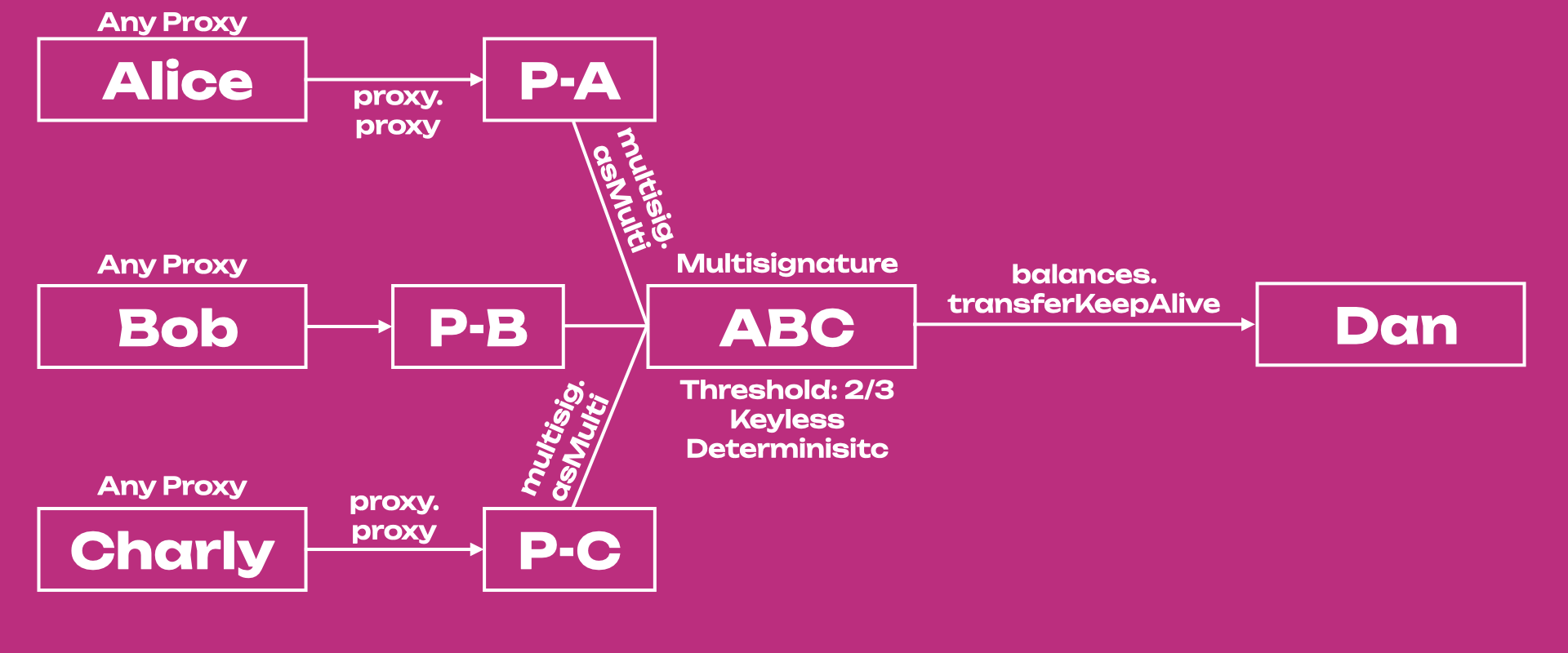 In the diagram above, Alice submits the `proxy.proxy` extrinsic to P-A, which in turn submits the `multisig.asMulti` extrinsic containing the `balances.transferKeepAlive` extrinsic about the transfer of some tokens from ABC to Dan. Then, Charly does the same to confirm the transaction. Note that Charly will need to pay for some weight, for the computation that is necessary to execute the transaction.
### Proxy calls[](https://wiki.polkadot.network/docs/learn-proxies-pure#proxy-calls)
Proxy calls are used by proxies to call proxied accounts. These calls are important for example in the case of *pure* proxies, as any attempt to sign transactions with a *pure* proxy will fail. For more details see the [dedicated section about anonymous proxies](https://wiki.polkadot.network/docs/learn-proxies-pure#anonymous-proxy-pure-proxy).
#### Nested Proxy Calls[](https://wiki.polkadot.network/docs/learn-proxies-pure#nested-proxy-calls)
As the term suggests, nested proxy calls are proxy calls within proxy calls. Such calls are needed if there are proxied accounts that are proxies themselves. In the example diagram below, Alice has a stash account that has a *staking* proxy account, P-C. P-C is a *pure* proxy, a proxied account originally spawned by Charly that is now an *any* proxy of P-C and signs everything on its behalf.
In the diagram above, Alice submits the `proxy.proxy` extrinsic to P-A, which in turn submits the `multisig.asMulti` extrinsic containing the `balances.transferKeepAlive` extrinsic about the transfer of some tokens from ABC to Dan. Then, Charly does the same to confirm the transaction. Note that Charly will need to pay for some weight, for the computation that is necessary to execute the transaction.
### Proxy calls[](https://wiki.polkadot.network/docs/learn-proxies-pure#proxy-calls)
Proxy calls are used by proxies to call proxied accounts. These calls are important for example in the case of *pure* proxies, as any attempt to sign transactions with a *pure* proxy will fail. For more details see the [dedicated section about anonymous proxies](https://wiki.polkadot.network/docs/learn-proxies-pure#anonymous-proxy-pure-proxy).
#### Nested Proxy Calls[](https://wiki.polkadot.network/docs/learn-proxies-pure#nested-proxy-calls)
As the term suggests, nested proxy calls are proxy calls within proxy calls. Such calls are needed if there are proxied accounts that are proxies themselves. In the example diagram below, Alice has a stash account that has a *staking* proxy account, P-C. P-C is a *pure* proxy, a proxied account originally spawned by Charly that is now an *any* proxy of P-C and signs everything on its behalf.
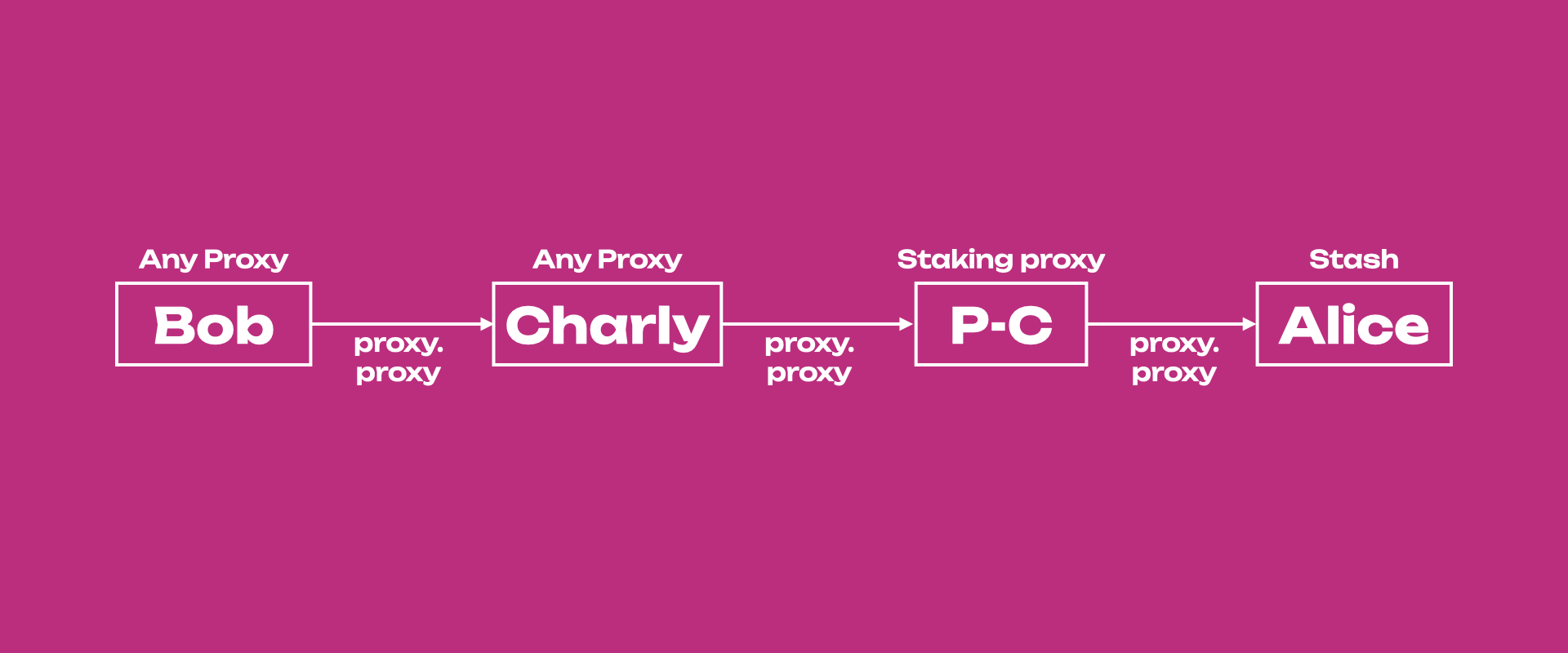 For example, to bond more funds, Charly needs to submit a `prox.proxy` extrinsic to P-C, which in turn submits a `proxy.proxy` extrinsic to Alice including for example a `staking.bondExtra` extrinsic, specifying the number of extra tokens that need to be bounded. If Charly wants to leave, a new account can take his place as any proxy (before Charly leaves!). There is no need to change the staking proxy account. Also, Alice is the only one who can remove P-C as a staking proxy, and P-C can only perform staking-related tasks. For example, P-C cannot send funds out from Alice's account.
Proxy calls can be done using the Extrinsic Tab in the Polkadot-JS UI. Nested proxy calls can be done by calling each `proxy.proxy` extrinsic separately, or in some cases by just calling the last `proxy.proxy` extrinsic. In the diagram above, submitting the proxy call from P-C to Alice will automatically ask for Charly's signature. Thus one proxy call will trigger the second one because Charly's is the only *any* proxy of P-C, and P-C cannot sign anything. While if we want to use Bob's account we will need to submit all three proxy calls.
For example, to bond more funds, Charly needs to submit a `prox.proxy` extrinsic to P-C, which in turn submits a `proxy.proxy` extrinsic to Alice including for example a `staking.bondExtra` extrinsic, specifying the number of extra tokens that need to be bounded. If Charly wants to leave, a new account can take his place as any proxy (before Charly leaves!). There is no need to change the staking proxy account. Also, Alice is the only one who can remove P-C as a staking proxy, and P-C can only perform staking-related tasks. For example, P-C cannot send funds out from Alice's account.
Proxy calls can be done using the Extrinsic Tab in the Polkadot-JS UI. Nested proxy calls can be done by calling each `proxy.proxy` extrinsic separately, or in some cases by just calling the last `proxy.proxy` extrinsic. In the diagram above, submitting the proxy call from P-C to Alice will automatically ask for Charly's signature. Thus one proxy call will trigger the second one because Charly's is the only *any* proxy of P-C, and P-C cannot sign anything. While if we want to use Bob's account we will need to submit all three proxy calls.